
Purity isn't identity: why peptide analysis needs orthogonal methods
31 October 2026
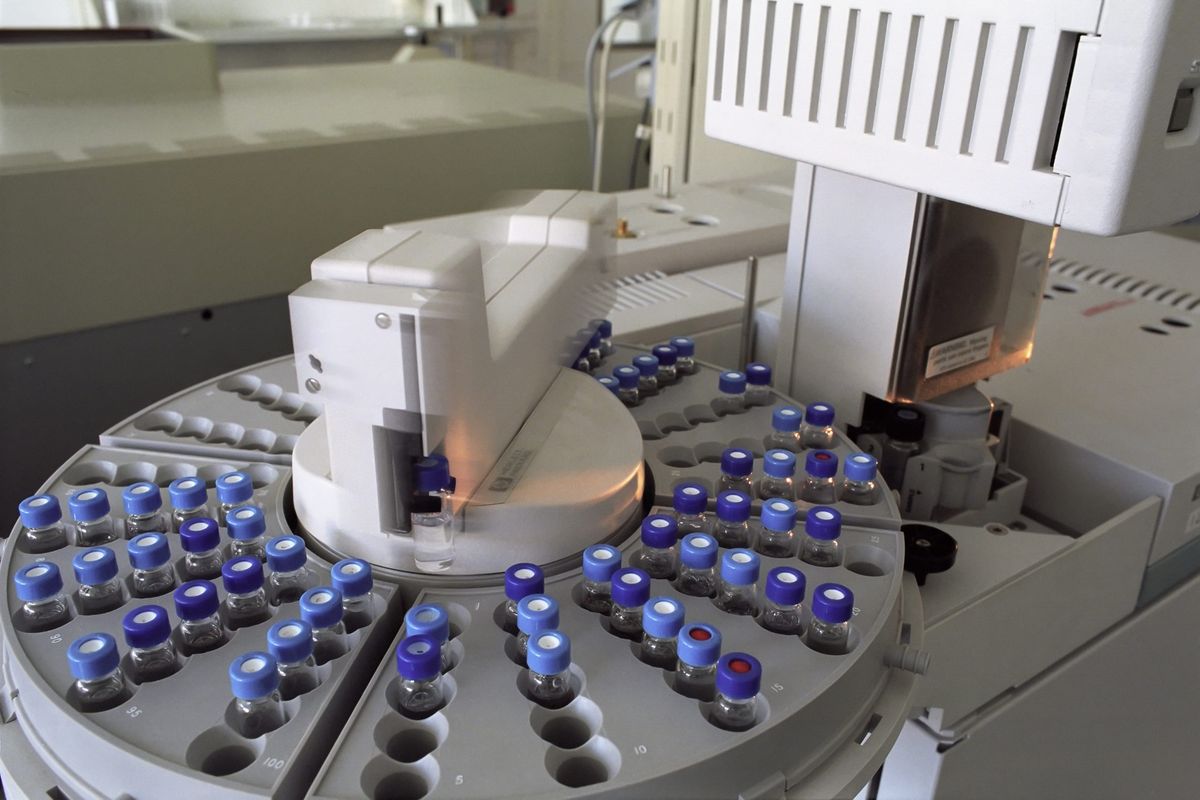
Most peptide certificates of analysis rest on two results: an HPLC purity percentage and a mass spectrometry result that matches the expected molecular weight. Both are useful, but they answer different questions, and each has blind spots. Knowing where those blind spots are helps you decide whether a batch is fit for a particular experiment.
What HPLC purity does and doesn't tell you
Reversed-phase HPLC with UV detection (usually 210–220 nm, where the peptide bond absorbs) separates components and reports the main peak's share of the total peak area. It does not tell you:
- What the main peak is. Retention time alone doesn't confirm identity.
- Whether something co-elutes. A closely related impurity can sit under the main peak. A second method with different selectivity (another column chemistry or mobile-phase pH) is the usual check.
- How much of the powder is peptide. Water, counter-ions (often trifluoroacetate from purification) and salts are invisible to UV. A 99% pure sample can have a net peptide content of 70–80%. That matters when you weigh out material for a concentration-dependent assay.
What a matching mass does and doesn't tell you
MS confirms that a species with the right mass is present, and it is good at spotting deletion or truncated sequences, incomplete deprotection and oxidation, because each changes the mass. It cannot tell apart species that have the same mass:
- Epimers. A single residue racemised during coupling (cysteine and histidine are the usual suspects) gives a D-amino acid diastereomer with an identical formula.
- Aspartate isomerisation. Asp → isoAsp (via a succinimide intermediate, especially at Asp-Gly sites) leaves the mass unchanged.
- Sequence scrambles. Two residues in swapped positions give the same composition and the same intact mass.
The orthogonal toolkit
- LC-MS/MS fragmentation (peptide mapping): confirms the sequence residue by residue, and places modifications.
- Chiral amino acid analysis: hydrolyse, derivatise with Marfey's reagent (FDAA) or similar, and separate the D and L forms. This is the direct test for racemisation.
- Amino acid analysis or quantitative NMR: net peptide content, so you know how much peptide you are actually weighing.
- Karl Fischer titration and ion chromatography: water and counter-ion content.
- Endotoxin (LAL) testing: relevant for cell-based work, where endotoxin can confound results at very low levels.
- A second HPLC method: different selectivity, to rule out co-elution.
A practical checklist for a CoA
- Is the report for this lot, and does the lot number match your vial?
- Is the HPLC method stated (column, gradient, wavelength), with the chromatogram or peak table?
- Is the MS result the observed mass, with the expected mass alongside?
- Is net peptide content or counter-ion content given? If not, factor that into how you prepare concentrations.
- For experiments that are sensitive to stereochemistry or endotoxin, have those been tested, or do you need to arrange it?
No single number makes a batch fit for every use. The right level of characterisation depends on the experiment. Purity plus identity is the floor, not the ceiling.
Further reading
- ICH Q2(R2): Validation of analytical procedures (2023). ich.org quality guidelines
- ICH Q6B: Specifications for biotechnological/biological products. ich.org quality guidelines
- Marfey P. Determination of D-amino acids as diastereomeric derivatives using 1-fluoro-2,4-dinitrophenyl-5-L-alanine amide. Carlsberg Res. Commun. 49, 591–596 (1984).
Photo: Yuri Shkoda / Pexels